Case study · Telecommunications
AI-powered next best action for a major US wireless carrier
Generative AI, omnichannel orchestration and a value realization office built into a carrier's next-best-action capability, rolled out to customers in measured stages.
Reported outcomes
Figures as reported in the original published case study.
- Improvement in NBA response performance
- 120%Improvement in NBA response performanceReported
- Content variants through AI-authored generation
- 5xContent variants through AI-authored generationReported
- Channels deployed in a single sprint, with the same resource pool
- 2 → 8Channels deployed in a single sprint, with the same resource poolReported
- Less operational headcount required
- 50%Less operational headcount requiredReported
Context
The CEO of a major US carrier's wireless business set a clear directive: embed artificial intelligence throughout the business to change scale, efficiency and customer engagement.
At the center was the carrier's next-best-action (NBA) capability, the system that decides what each customer sees next. Earlier attempts by large consulting firms had stalled. Blend360 was brought in as strategic architect and integrator, with senior teams working alongside the client's own product owners.
The mandate
Exponential scale, with half the operational effort
The brief was to build an omnichannel, AI-infused NBA ecosystem that could scale sharply while cutting operational overhead by more than half.
- Embed generative AI to accelerate content production and compliance approval
- Reduce campaign operations headcount by more than 50%
- Improve NBA commercial outcomes across channels and lines of business
- Expand NBA orchestration from two channels to ten, concurrently
Why it was hard
A configuration tool built for one channel at a time
The existing configuration tool was not designed for omnichannel logic, AI-authored content or multi-system orchestration. Generative AI had already failed to integrate into the NBA workflow three times.
Early in the program, product groups agreed on an AI-first vision but not on sequencing, architectural dependencies or delivery ownership. That misalignment created delivery bottlenecks.
The approach
A value realization office beside delivery
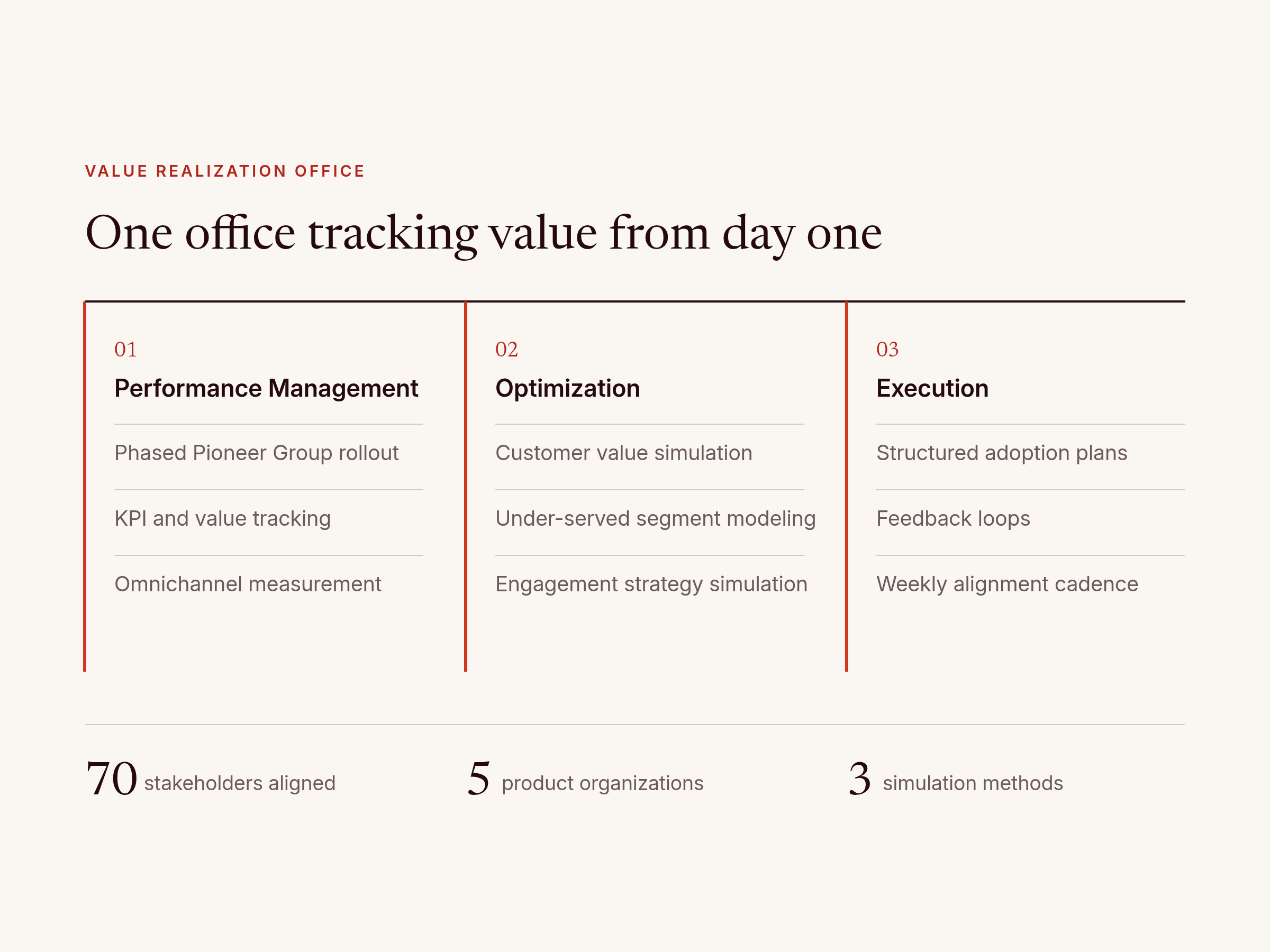
Blend360 set up a Value Realization Office with three workstreams and acted as both solution architect and delivery orchestrator. Planning summits and steering councils aligned 70 stakeholders across marketing, product, CX, AI and technology. Epic-level documentation spanned five product organizations to keep the backlog intact.
Rollout
Prove it on 1.5% before scaling to 98.5%
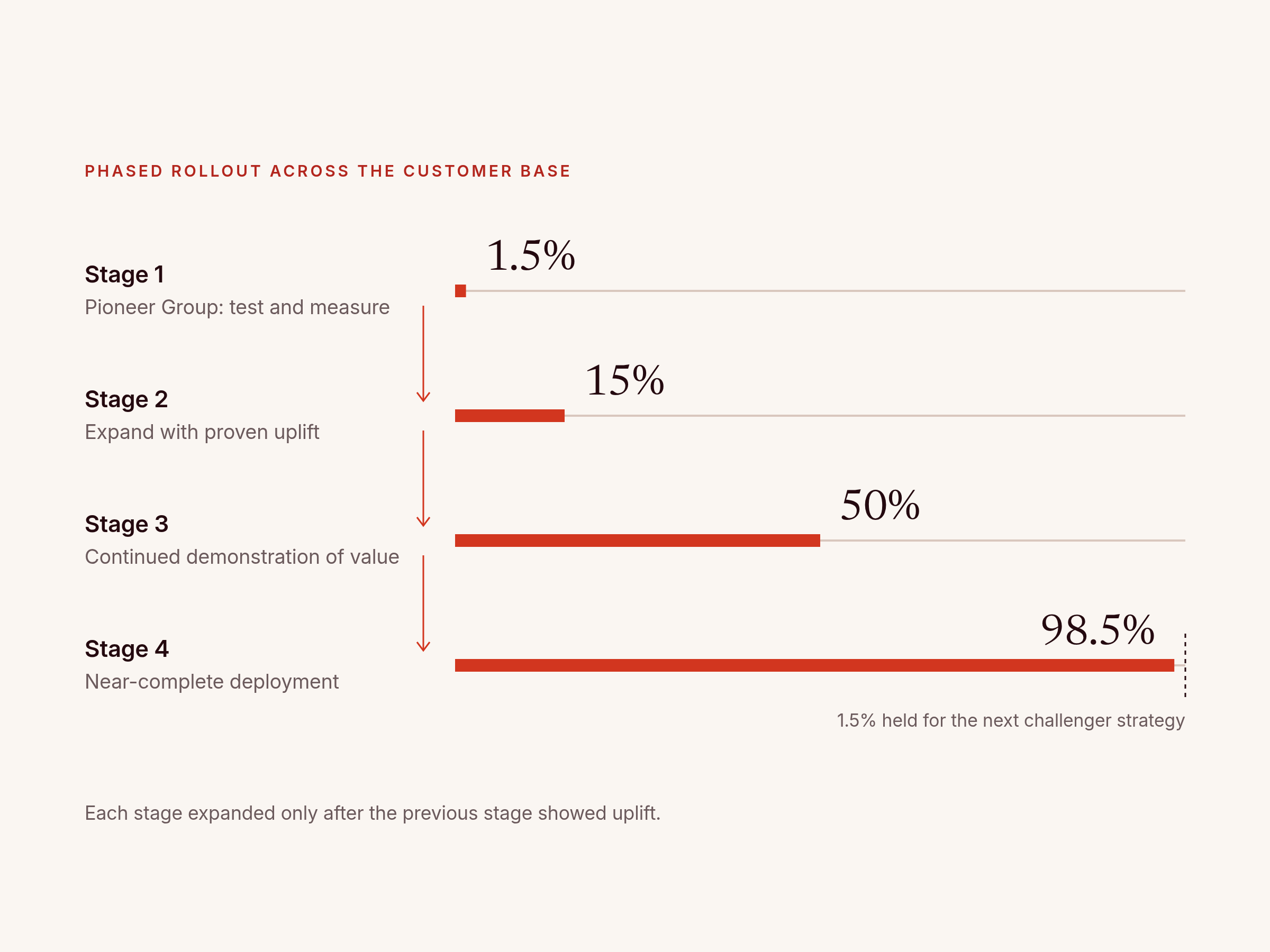
New strategies went first to a Pioneer Group of 1.5% of customers. Each expansion, to 15%, then 50%, then 98.5%, followed demonstrated uplift. The remaining 1.5% stays reserved for testing the next challenger strategy.
Three business simulation methods supported the rollout: customer value tracking across segments, interactions and proposition mixes; modeled outcomes for under-served segments; and simulated changes to engagement strategy.
Orchestration
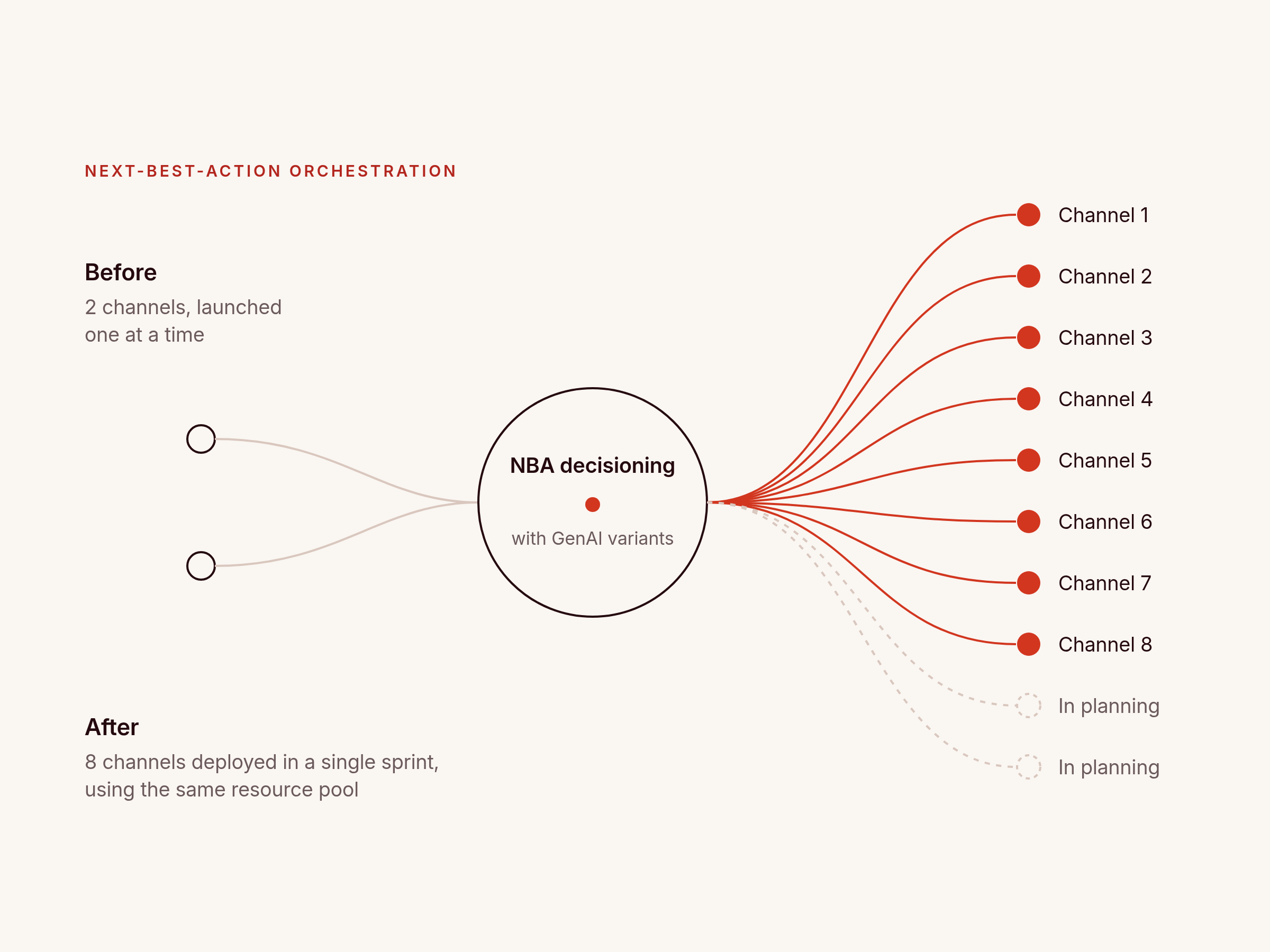
From one channel at a time to eight in a sprint
Configuration moved from single-channel set-up with no AI support to generated content variants and channel-agnostic logic. The work shaped rule testing and simulation layers, persona-based configuration, variant generation with explainability, and deployment rollback for risk control.
“Prior to Blend's involvement, the generative AI initiative had started and failed at least three times. They're the first team that successfully integrated it.”
“Multiple SIs and consulting teams tried to re-architect our ecosystem. Blend built a plan we could finally follow, deploy, and measure real change.”
Outcomes
Reported outcomes
Figures as reported in the original published case study.
| Figure | What it measures | Status |
|---|---|---|
| 120% | Improvement in NBA response performance | Reported |
| 5x | Content variants through AI-authored generation | Reported |
| 2 → 8 | Channels deployed in a single sprint, with the same resource pool | Reported |
| 50% | Less operational headcount required | Reported |
What came next
The carrier asked Blend360 to support its broader agentic AI program.
- A backlog of agent use cases
- Agent design frameworks and orchestration logic
- System architecture for agent-to-tool coordination
Lessons
Persistence through process
Design-thinking workshops, backlog stewardship, architecture documentation and weekly alignment carried the program through friction.
Trust follows delivery
Resistance turned into alignment once the first pilot worked. In one stakeholder's words: “Once we saw it work, everyone wanted to get on board.”
Next case study
Financial services: A value realization office and hub-and-spoke model aimed at taking campaign delivery from 16 weeks toward 16 hours.Working on something similar?
ryan.serpan@gmail.com