Case study · Financial services
Rebuilding marketing execution for a global card brand
A value realization office and hub-and-spoke operating model aimed at taking campaign delivery from more than 16 weeks toward 16 hours.
Reported outcomes
Figures as reported in the original published case study.
- Work efforts standardized, reducing dependence on tribal knowledge
- 100+Work efforts standardized, reducing dependence on tribal knowledgeReported
- Transformation pillars in one framework
- 6Transformation pillars in one frameworkScope
- Cycle-time reduction projected within the first 6–12 months
- 10%+Cycle-time reduction projected within the first 6–12 monthsProjected
- Campaign delivery goal, down from 16+ weeks
- 16 hCampaign delivery goal, down from 16+ weeksTarget
Context
One of the world's largest credit card brands needed to modernize how marketing gets work out the door. Campaigns took more than 16 weeks from inception to launch, too slow for a digital-first market.
The goal it set was to cut campaign delivery from 16 weeks to 16 hours, while improving governance, data use and customer focus. A previous six-month engagement with another consultancy had produced little progress.
The challenge
Marketing gridlock
Teams relied on ad hoc processes and tribal knowledge. Automation platforms and customer data platforms had underperformed because the operating foundations under them were weak.
- Campaigns took 16+ weeks from conception to launch
- Siloed operations with no shared standards
- Technology investments that did not pay back
Principles
Push products, not buttons
The program set four principles before any tooling changed: shift marketers from administration to customer-centered work; build foundations before automation; let processes drive applications, not the reverse; and bring the customer's voice into every planning stage.
Ignite 360
A control tower for the transformation
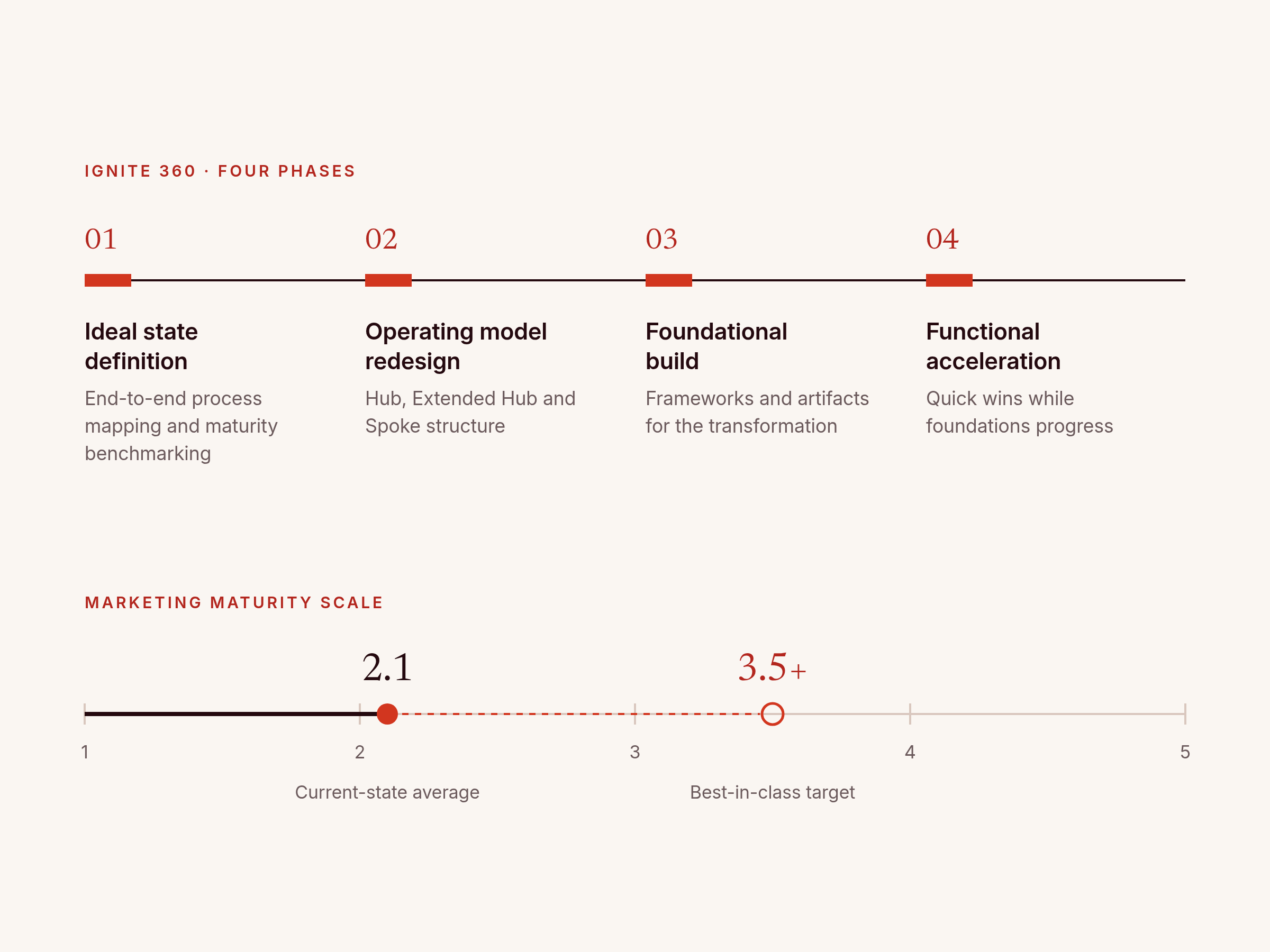
The team established Ignite 360, a value realization office that orchestrated the program in four phases. Benchmarking put current maturity at an average of 2.1, against a best-in-class target of 3.5 or higher.
Operating model
Hub, Extended Hub and Spoke
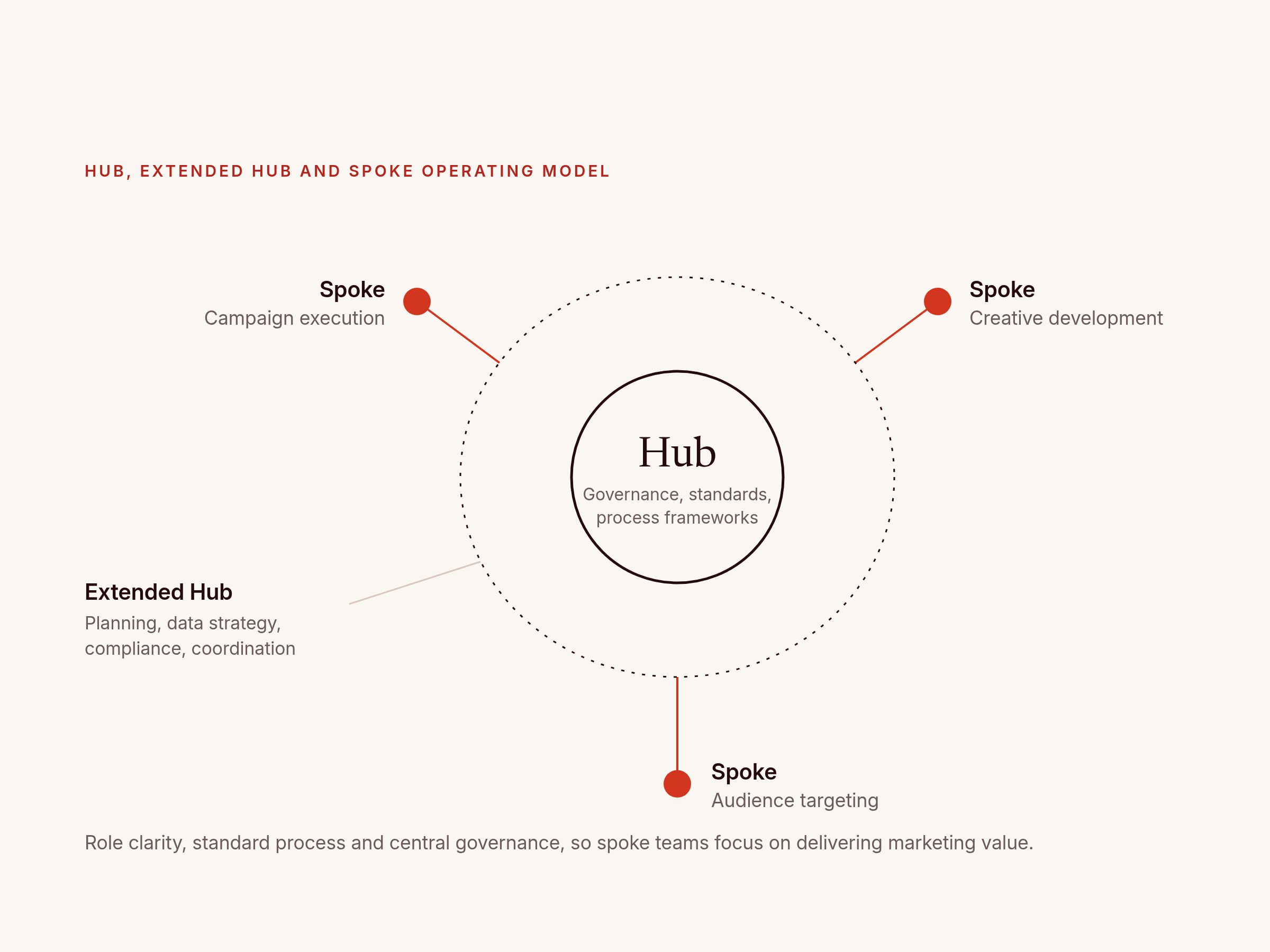
A hub, extended hub and spoke structure replaced hierarchical bottlenecks. The hub owns governance, compliance standards and process frameworks. The extended hub covers planning, data strategy, compliance and coordination. Spoke teams focus on campaign execution, creative development and audience targeting.
Framework
Six pillars, addressed together
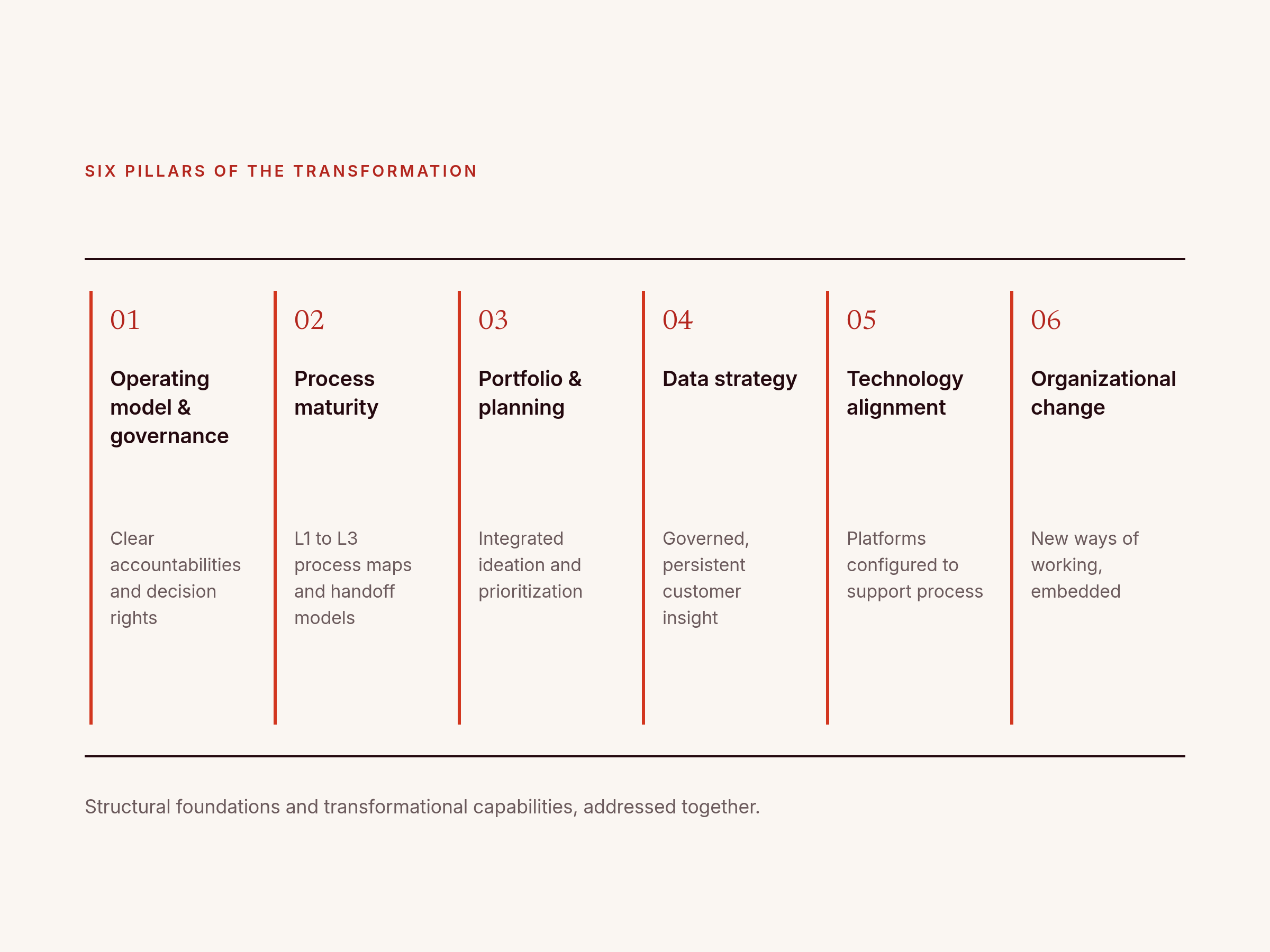
Structural foundations and transformational capabilities were treated as one program rather than separate projects.
Outcomes
Reported outcomes
Figures as reported in the original published case study. The 16-hour figure is the program's goal; it has not been reported as achieved. The cycle-time figure is a projection.
| Figure | What it measures | Status |
|---|---|---|
| 100+ | Work efforts standardized, reducing dependence on tribal knowledge | Reported |
| 6 | Transformation pillars in one framework | Scope |
| 10%+ | Cycle-time reduction projected within the first 6–12 months | Projected |
| 16 h | Campaign delivery goal, down from 16+ weeks | Target |
Where it leaves marketing
An enterprise campaign execution hub, standards across marketing functions, and a repeatable model for other business units.
- From siloed to centralized
- From ad hoc to governed
- From product-centric to customer-centric
Lessons
A value office keeps the goal honest
Tracking maturity and value centrally kept a bold target tied to measurable steps.
Structure before technology
Operating model, process and culture had to move before platforms could deliver.
Next case study
Telecommunications: Generative AI and omnichannel orchestration built into a wireless carrier's next-best-action engine.Working on something similar?
ryan.serpan@gmail.com